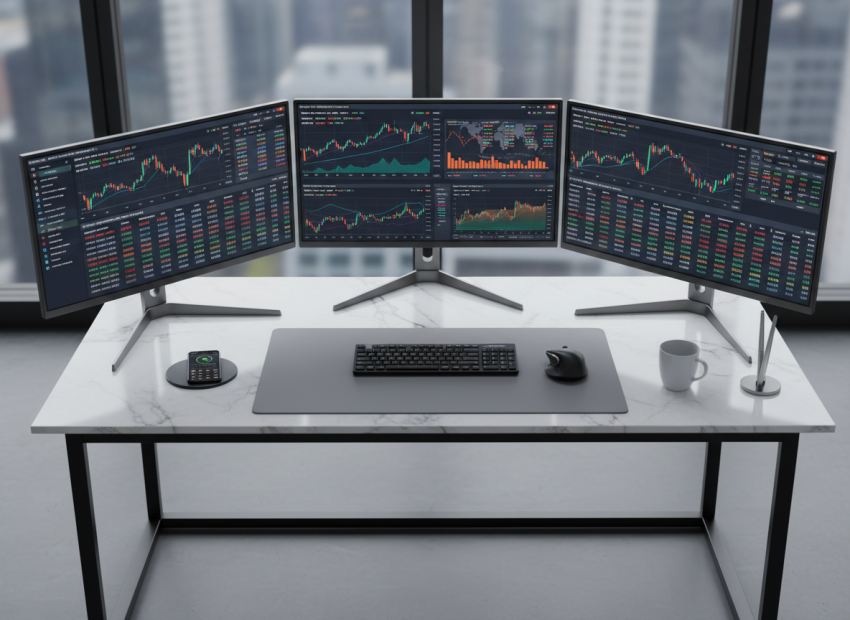
In today’s fast-paced global markets, selecting a premier brokerage firm is the most critical decision a professional trader can make. Whether you are navigating the complexities of forex, scaling equity positions, or diversifying into commodities, the right partner provides more than just market access. It offers a sophisticated ecosystem of advanced trading platforms, institutional-grade market execution speed, and robust security through FCA regulated or SEC registered frameworks.
This comprehensive review evaluates the top ten best brokers in the world, focusing on the metrics that matter most to serious investors:
-
Commission-free trading structures and low-spread environments.
-
Depth of available asset classes and liquidity.
-
Reliability of professional-grade trading tools and analytics.
We aim to bridge the gap between retail accessibility and institutional performance, helping you secure a platform that aligns with your strategic objectives.
Defining Excellence: What Professionals Look for in a Broker
For professional traders, selecting a brokerage firm is paramount, demanding a robust partnership built on trust and advanced capabilities. Defining excellence starts with an unwavering commitment to regulatory compliance and stringent security standards. These critical safeguards protect capital and ensure market integrity, forming the bedrock for all professional considerations.
Beyond these foundational assurances, modern professionals demand sophisticated tools and seamless execution. A broker’s technological prowess, encompassing advanced trading platforms and comprehensive technology suites, is equally pivotal, empowering traders with the speed, data, and analytical depth needed to navigate complex markets.
Regulatory Compliance and Security Standards
For professional traders, regulatory compliance is the non-negotiable bedrock of any partnership. Top-tier online brokerages must hold licenses from reputable "Tier-1" jurisdictions, such as the FCA (UK), ASIC (Australia), or the SEC and CFTC (USA). These bodies ensure that financial intermediaries adhere to strict capital requirements and ethical conduct.
Beyond basic licensing, security standards include:
-
Segregated Client Funds: Ensuring capital is held separately from the firm’s operational accounts.
-
Negative Balance Protection: Preventing losses from exceeding account balances.
-
Data Integrity: Utilizing SSL encryption and mandatory 2FA to protect brokerage accounts.
Verifying a broker’s regulatory status via official registers is the first step in mitigating counterparty risk and ensuring long-term capital safety.
Advanced Trading Platforms and Technology Suites
Beyond security, a professional’s edge lies in their technology suite. Top-tier brokers distinguish themselves by offering a choice between industry-standard platforms like MetaTrader 5 (MT5) and high-performance proprietary software. For professionals, market execution speed is non-negotiable; low-latency environments and VPS hosting are essential to minimize slippage during high volatility.
Key technological requirements include:
-
Advanced Charting: Sophisticated technical indicators and drawing tools for deep analysis.
-
Algorithmic Support: Robust API connectivity for automated strategies and custom scripts.
-
Depth of Market (DoM): Direct visibility into liquidity layers and order book transparency.
-
Cross-Device Parity: Seamless transition between desktop power and mobile agility.
Whether utilizing cTrader for its ECN-style interface or a broker’s custom-built terminal, the platform must facilitate complex order types and rapid-fire decision-making.
Key Evaluation Metrics for Top-Tier Brokers
While cutting-edge technology provides the foundation for professional trading, the economic efficiency of a broker determines long-term profitability. For high-volume traders, even marginal differences in pricing or liquidity can significantly impact the bottom line. Therefore, evaluating a firm requires a granular look at its cost structures and the depth of its market access.
To rank the world’s elite providers, we apply rigorous benchmarks across two primary pillars:
-
Financial Transparency: Analyzing the total cost of ownership beyond simple spreads.
-
Market Robustness: Assessing the breadth of instruments and the quality of execution environments.
By analyzing these metrics, professionals can distinguish between a standard retail service and a true institutional-grade partner capable of supporting sophisticated strategies.
Fees, Spreads, and Commission Structures
For professional traders, the cost of doing business extends far beyond headline commissions. Top-tier brokers typically offer two primary pricing models:
-
Spread-only accounts: Often commission-free but with wider markups, suitable for longer-term position traders.
-
ECN/STP accounts: Featuring raw spreads (from 0.0 pips) plus a fixed commission per lot, preferred by high-frequency traders.
Professionals generally favor the ECN model for its transparency and tighter pricing during high-liquidity periods. However, a comprehensive evaluation must also include swap rates (overnight financing), slippage (the difference between expected and executed price), and non-trading fees such as inactivity or withdrawal charges. Minimizing these friction costs is essential for maintaining a sustainable edge in global markets.
Asset Diversity, Liquidity, and Execution Speed
Beyond cost, professional performance hinges on the breadth of available asset classes and the technical efficiency of the trade environment. A top-tier broker must provide deep liquidity to ensure that large-volume orders are filled with minimal slippage. This is particularly vital for high-frequency traders who rely on market execution speed measured in milliseconds.
Professional-grade platforms typically offer:
-
Multi-asset access: Seamlessly switching between forex, global stocks, indices, and commodities.
-
Direct Market Access (DMA): Connecting traders directly to liquidity providers for transparent pricing.
-
Low Latency Infrastructure: Utilizing high-speed servers located near major exchanges to minimize delays.
Evaluating these metrics ensures that your strategy isn’t undermined by technical bottlenecks or limited market reach.
The Top Ten Best Brokers in the World for Professionals
Identifying the elite tier of financial intermediaries requires moving beyond basic features to evaluate how firms handle high-volume, precision-dependent strategies. Having established the critical importance of market execution speed and deep liquidity, we now turn our focus to the specific trading platforms that consistently meet these professional benchmarks. These brokerage accounts represent the pinnacle of the industry, balancing robust trading tools with stringent FCA regulated or SEC registered oversight.
The following selection highlights the top ten providers globally, curated for their ability to deliver institutional-grade environments to retail and professional traders alike. Whether you prioritize commission-free trading or multi-asset versatility, these firms define the current gold standard in global finance.
Overview of Leading Brokerage Firms
The global brokerage landscape is dominated by a few elite firms that consistently outperform in execution speed and regulatory compliance. Interactive Brokers (IBKR) remains the benchmark for professionals, offering unparalleled market depth and a sophisticated TWS platform. For US-based traders, tastyfx (IG Group) provides a secure, CFTC-regulated environment with competitive pricing and high-tier security.
Other market leaders include:
-
MultiBank Group: Renowned for its massive library of 20,000+ assets and institutional-grade ECN account structures.
-
Plus500: A top-tier choice for commission-free trading via an intuitive proprietary interface, backed by FCA and CySEC oversight.
-
Exness: Highly regarded for its transparent operational metrics and high-volume execution capabilities.
These firms represent the pinnacle of reliability, catering to diverse strategies from high-frequency scalping to long-term multi-asset portfolio management.
Brief Profiles and Key Strengths of Each Top Broker
-
Interactive Brokers: The premier choice for institutional-grade execution, offering the advanced TWS platform and unparalleled multi-asset access.
-
tastyfx (IG): A top-tier, US-regulated firm providing sophisticated interfaces and deep liquidity for professional forex traders.
-
Plus500: Delivers a streamlined, commission-free experience backed by robust FCA oversight and an intuitive proprietary platform.
-
MultiBank Group: Distinguished by a massive library of 20,000+ instruments and raw ECN spreads from 0.0 pips.
-
Exness: Renowned for operational transparency and high-volume execution reliability.
-
Saxo Bank: Offers premium research and elite security standards for high-net-worth investors.
-
CMC Markets: Features industry-leading charting tools and highly competitive pricing for active day traders.
-
OANDA: Highly regarded for its historical data integrity and seamless API integration for automated strategies.
-
eToro: The global leader in social copy-trading and multi-asset diversification.
-
Admiral Markets: Exceptional for its MetaTrader enhancements and strong European regulatory framework.
In-Depth Comparison and Specialized Offerings
Having established the unique value propositions and core strengths of the world’s leading brokerage firms, this section transitions into a more granular examination. We will conduct an in-depth, feature-by-feature comparison of their advanced trading platforms, comprehensive toolsets, and dedicated support services.
This detailed analysis is designed to empower professional traders in aligning specific broker offerings with their individual strategic needs and operational demands, ensuring an optimal choice for their sophisticated trading endeavors.
Feature-by-Feature Comparison: Platforms, Tools, and Support
Professional traders require a synergy between robust software and responsive assistance. While industry standards like MetaTrader 4 (MT4) and MT5 remain staples for their algorithmic capabilities, proprietary platforms often provide a more streamlined user experience and unique data integrations.
| Feature | High-Tier Standard | Professional Edge |
|---|---|---|
| Platforms | MT4, MT5, WebTrader | TWS, MultiBank-Plus, IRESS |
| Analysis Tools | Basic Charting, News Feeds | Level II Depth, Advanced Backtesting |
| Execution | Standard Market Execution | Ultra-low Latency / ECN Raw Spreads |
| Support | 24/5 Live Chat, FAQ | Dedicated Account Manager, 24/7 Priority |
Beyond software, the quality of customer support and educational suites—ranging from institutional-grade research to live webinars—distinguishes top-tier financial intermediaries. For those prioritizing speed, market execution speed and low-latency connectivity are non-negotiable metrics that separate retail-focused apps from professional-grade brokerage accounts.
Broker Suitability: Best for Specific Professional Strategies
Building on the robust technical foundations discussed, selecting a broker also hinges on its alignment with specific professional trading strategies.
-
For High-Frequency Trading and Scalping: Brokers offering ECN accounts with raw spreads and ultra-fast execution are paramount. MultiBank Group stands out with its ECN accounts and 0.0 pip spreads, ideal for strategies demanding minimal latency.
-
For Algorithmic and Data-Driven Strategies: Platforms providing extensive customization, deep market data, and API access are crucial. Interactive Brokers (IBKR) excels, catering to seasoned traders who leverage complex, multi-asset workflows and require granular order control.
-
For Diversified Portfolio Management: Access to a broad range of asset classes and comprehensive research tools is key. tastyfx (formerly IG U.S.) and MultiBank Group both offer extensive instrument selections, supporting professionals managing varied portfolios across forex, CFDs, and other assets.
Optimizing Your Broker Choice: Advanced Considerations
Selecting the right partner involves moving beyond general rankings to scrutinize the specific operational levers that impact long-term profitability. While strategic alignment is vital, the fine-tuning of your trading environment often hinges on the technicalities of capital deployment and the quality of the human-to-machine interface.
To achieve peak performance, professionals must weigh the following advanced variables:
-
Structural Efficiency: How account tiers and capital requirements influence your margin.
-
Service Integrity: The depth of technical support and the overall fluidity of the user interface.
These elements ensure that your chosen platform remains an asset rather than a bottleneck during periods of high market volatility.
Leverage, Account Types, and Minimum Deposit Requirements
Professional traders must balance capital efficiency with risk management through the strategic application of leverage. While retail limits are strictly capped at 30:1 or 50:1 by top-tier regulators like the FCA or CFTC, professional-designated accounts can often unlock higher ratios. Selecting the appropriate account type is equally vital for optimizing overhead:
-
Standard Accounts: Ideal for those preferring simplified, commission-free pricing structures.
-
ECN/Raw Spread Accounts: The gold standard for professionals, offering direct market access and near-zero spreads in exchange for a fixed commission.
-
VIP/Institutional Tiers: These require substantial minimum deposits—often exceeding $10,000—but provide high-volume traders with significant rebates and priority execution speeds.
Customer Service Quality and User Experience
For professional traders, the quality of customer support and the seamlessness of the user experience (UX) are non-negotiable. High-stakes trading requires immediate access to technical assistance, ideally through 24/7 multi-channel support including live chat, direct phone lines, and dedicated account managers.
Key UX indicators for top-tier online brokerages include:
-
Platform Stability: Minimal downtime and rapid market execution speed across desktop and mobile apps.
-
Intuitive Interface: A clean, customizable dashboard that reduces cognitive load during high-volatility periods.
-
Resource Integration: Seamless access to real-time news feeds, advanced charting, and sentiment analysis within the trading environment.
The best financial intermediaries distinguish themselves by offering localized support and streamlined KYC processes, ensuring that the focus remains on market performance rather than administrative friction.
Making Your Informed Choice: Selecting the Ideal Professional Broker
Having thoroughly examined the critical aspects of top-tier brokerage, from regulatory compliance and advanced platforms to fee structures and asset diversity, we now arrive at the pivotal stage: making an informed decision. The preceding discussions, including the importance of responsive support and intuitive design, have equipped you with a robust framework. This section will guide you in synthesizing these insights to select a broker that perfectly aligns with your unique professional trading needs and strategic objectives.
Tailoring Your Selection to Individual Trading Needs
Selecting the ideal partner requires aligning a firm’s infrastructure with your operational strategy. Professionals should categorize their needs into three primary profiles:
-
Active Day Traders: Prioritize market execution speed, low latency, and raw spreads. Look for ECN environments to minimize slippage.
-
Multi-Asset Investors: Focus on asset classes diversity and robust research tools for global portfolio management.
-
Beginners & Scalpers: Seek intuitive interfaces or advanced trading tools like Depth of Market (DOM) depending on technical proficiency.
Always verify the provider is FCA regulated or SEC registered to ensure institutional-grade security. Matching your specific volume and technical requirements optimizes your long-term trading overhead.
Future Trends and Innovations in Professional Brokerage
The professional brokerage landscape is shifting toward a more integrated, data-centric future. As you finalize your choice, consider how these innovations might impact your long-term strategy:
-
Artificial Intelligence & Machine Learning: Beyond basic bots, AI is now powering predictive market sentiment and advanced risk management tools that adapt to volatile conditions in real-time.
-
Tokenization of Assets: The rise of blockchain-based settlement is paving the way for fractional ownership of high-value assets and near-instant market execution speed, reducing the traditional T+2 settlement lag.
-
Enhanced RegTech: Top-tier firms are utilizing automated compliance (RegTech) to maintain FCA and SEC standards without compromising liquidity or the user experience.
-
Mobile-First Professionalism: The gap between desktop and mobile trading platforms is closing, with full-feature parity and institutional-grade charting becoming the industry standard for traders on the move.
Conclusion
Selecting the ideal brokerage firm is the final, most critical step in your professional journey. Whether you prioritize FCA regulated security, commission-free trading, or superior market execution speed, your choice must align with your specific strategy and risk profile. By evaluating asset classes, trading tools, and minimum deposit requirements, you can secure a platform that offers both reliability and a competitive edge in today’s evolving global markets.