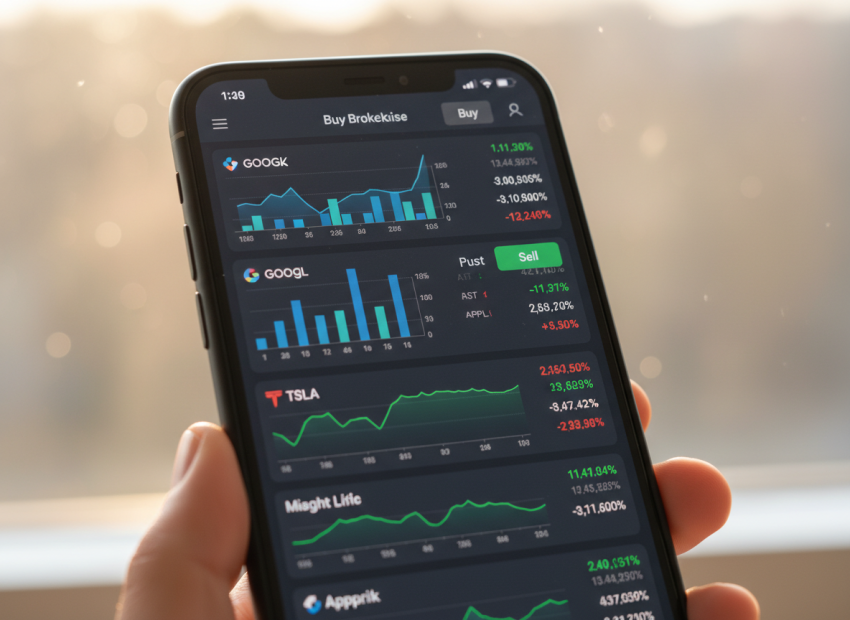
The landscape of retail investing has undergone a radical transformation. Gone are the days when sophisticated market access was reserved for institutional desks or clunky desktop terminals. Today, mobile trading platforms have democratized the financial markets, putting institutional-grade market research tools and global execution in the palm of your hand.
Whether you are looking for commission-free trading, the ability to buy fractional shares, or advanced options trading apps, the sheer volume of choices can be overwhelming. This review evaluates the leading online brokers to help you navigate the trade-offs between ease of use and technical depth. We analyze how these investment apps cater to diverse styles—from long-term ETF investing to high-frequency technical analysis—ensuring your chosen platform aligns with your financial trajectory.
The Rise of Mobile Investing: Why Stock Apps Matter
The shift from desktop-bound terminals to pocket-sized powerhouses has fundamentally altered the financial landscape. Today, the ability to execute complex trades or rebalance a portfolio while commuting is no longer a luxury—it is a standard expectation for the modern retail investor. This transition reflects a broader move toward instantaneous market access and real-time decision-making.
As we explore the current ecosystem, it becomes clear that mobile platforms are more than just simplified versions of their web counterparts. They represent a specialized environment where user experience (UX) and technical agility converge to meet the demands of a fast-paced global market.
The evolution of brokerage services to mobile platforms
The journey from traditional floor trading to modern mobile brokerage accounts represents a seismic shift in financial accessibility. Initially, retail investors were tethered to desktop terminals or phone-based orders. However, the mid-2010s fintech explosion—led by pioneers like Robinhood and Webull—disrupted this model by prioritizing a mobile-first user experience.
This evolution occurred in three distinct stages:
-
Legacy Digitization: Traditional firms moved from paper to web-based portals.
-
The Commission-Free Revolution: Mobile-native apps introduced zero-fee trading and fractional shares, forcing industry-wide fee compression.
-
Feature Parity: Modern apps now offer sophisticated options trading, real-time technical analysis, and institutional-grade research once reserved for desktop suites.
Today, the smartphone is the primary gateway for global market access, blending convenience with professional-grade execution.
Key advantages of using a dedicated stock app for trading and investing
Dedicated stock apps have revolutionized market participation by offering unprecedented accessibility. No longer tethered to desktops, investors can execute trades and monitor global volatility from anywhere.
Key advantages include:
-
Real-Time Responsiveness: Instant push notifications and live quotes allow for immediate reaction to market-moving news.
-
Enhanced User Experience: Streamlined interfaces simplify complex order entries and portfolio management compared to traditional web portals.
-
Cost-Efficiency: Many mobile-first platforms lead the way in commission-free trading and fractional shares, significantly lowering the barrier to entry.
-
Integrated Research: Modern apps consolidate market research tools and technical analysis into a single, portable ecosystem.
By bridging the gap between professional-grade analysis and retail convenience, these platforms empower users to maintain a disciplined investment strategy on the go.
Essential Criteria for Evaluating Brokerage Stock Apps
With the shift toward mobile-first investing, the sheer number of available investment apps can be overwhelming. Choosing the "best" platform is rarely about a single feature; rather, it is about how a broker balances commission-free trading, market research tools, and portfolio management capabilities.
To provide a transparent comparison, we evaluate each app against a standardized set of benchmarks designed to reveal its true value for different strategies, from ETF investing to complex options trading. By focusing on these core pillars, you can move beyond marketing claims to find a platform that aligns with your specific financial objectives and technical requirements.
Understanding our methodology: Fees, features, and user experience
To identify the premier mobile trading platforms, we employ a rigorous testing framework centered on three pillars: cost, functionality, and usability. Our methodology involves hands-on stress testing during live market hours to evaluate how these apps perform under high volatility.
-
Fee Transparency: We look past "commission-free" marketing to analyze per-contract options fees, margin rates, and account transfer (ACAT) costs.
-
Feature Set: We prioritize platforms offering fractional shares, real-time data feeds, and robust market research tools that translate well to smaller screens.
-
User Experience: We assess the "time-to-trade"—how intuitively a user can move from discovery to execution without technical friction.
This multi-dimensional approach ensures our recommendations serve both the cost-conscious beginner and the data-hungry active trader.
Tailoring your choice: Different app needs for different investor types
Selecting the right mobile trading platform depends entirely on your specific objectives and experience level. While a professional might prioritize Interactive Brokers for its institutional-grade charting and global market access, a novice should look for apps like Fidelity or Schwab that offer robust educational "learning paths" and fractional shares to lower the barrier to entry.
Consider these primary investor profiles:
-
The Novice: Needs an intuitive UI, paper trading, and extensive glossaries to build confidence.
-
The Active Trader: Requires real-time Level II data, advanced order types (bracket orders), and technical indicators.
-
The Long-Term Strategist: Values ETF screeners, automated dividend reinvestment (DRIP), and low-cost IRA management.
Matching the app to your "investor DNA" ensures you do not pay for unused features or lack the tools necessary for your strategy.
Top Apps for Beginner Investors and Long-Term Growth
For those just starting their financial journey, the priority shifts from complex technical indicators to accessibility and education. The modern brokerage landscape has evolved to lower the barriers to entry, allowing retail investors to start with small amounts while learning the ropes.
These platforms excel by offering intuitive interfaces that strip away the intimidation factor of traditional terminals. Whether you are looking to build a retirement nest egg or simply buy your first slice of a blue-chip company, the following apps provide the necessary guardrails and tools to foster long-term success without overwhelming the user.
Platforms prioritizing ease of use, educational content, and guided investing
For investors just starting their journey, the best apps bridge the gap between market complexity and actionable knowledge. Charles Schwab and Fidelity lead the industry by integrating institutional-grade research into user-friendly mobile interfaces. Schwab’s "Stock Slices" and Fidelity’s fractional share capabilities allow beginners to build diversified portfolios with as little as $1.
Key features to look for in these platforms include:
-
Curated Learning Paths: Structured modules that explain ETF investing and risk management.
-
Paper Trading: Risk-free environments to practice execution before committing capital.
-
Simplified Order Entry: Intuitive trade flows that prevent common execution errors.
Robinhood also remains a top contender for its streamlined UI, though it prioritizes simplicity over deep fundamental data. These platforms ensure that your first trade is backed by education rather than guesswork.
Apps offering fractional shares, low minimums, and automated investing options
Modern brokerage apps have dismantled traditional barriers to entry by integrating fractional shares and zero-minimum accounts. Platforms like Robinhood and Fidelity allow users to purchase high-priced equities with as little as $1, facilitating instant diversification for those with limited capital. For investors prioritizing a "set-and-forget" strategy, automated investing tools—such as recurring buys and dollar-cost averaging (DCA) schedules—are now standard features.
| Feature | Leading Apps | Primary Benefit |
|---|---|---|
| Fractional Shares | Schwab, Robinhood, Fidelity | Buy expensive stocks by the dollar |
| Automated Investing | Webull, M1 Finance | Consistent wealth building via DCA |
| Low Minimums | Most major brokers | Start investing with $0 to $1 |
These mechanics ensure that small, consistent contributions can evolve into significant portfolios, making market access truly universal for the retail sector.
Advanced Features for Experienced and Active Traders
While platforms catering to beginner investors excel at simplifying market entry through fractional shares and automated investing, the needs of experienced and active traders are distinctly different. These seasoned participants require a more sophisticated toolkit to navigate complex market dynamics and execute advanced strategies effectively.
For those who engage in frequent trading, technical analysis, or options strategies, a basic interface simply won’t suffice. This section delves into brokerage stock apps that provide the robust features, real-time data, and analytical capabilities essential for high-performance trading and informed decision-making.
Brokerage apps with robust charting, market research, and real-time data
For active traders, the mobile experience must mirror the desktop’s power. Platforms like Interactive Brokers (IBKR) and Webull lead the pack by offering institutional-grade tools in a pocket-sized format.
-
Advanced Charting: Look for apps providing 50+ technical indicators, drawing tools, and customizable timeframes to identify patterns on the go.
-
Real-Time Data: Essential for day trading; top-tier apps offer Level II market depth and streaming quotes without latency.
-
Market Research: Access to premium reports from Morningstar or Lipper ensures your strategy is backed by data, not just intuition.
While thinkorswim (Schwab) remains a gold standard for technical analysis, Webull provides a more modern, streamlined interface for those prioritizing speed and real-time social sentiment.
Platforms supporting options trading, technical analysis, and advanced order types
Active traders require precision and flexibility that standard apps often lack. Leading platforms like Interactive Brokers (IBKR) and Webull provide sophisticated order types, including bracket orders, trailing stops, and One-Cancels-the-Other (OCO) instructions, which are vital for automated risk management in volatile markets.
For options enthusiasts, top-tier apps offer:
-
Multi-leg strategy builders: Seamlessly execute spreads, straddles, and iron condors from a mobile interface.
-
Real-time Greeks: Monitor Delta, Gamma, and Theta to manage position sensitivity.
-
Visual Risk/Reward Profiles: Analyze potential outcomes before committing capital.
Apps such as Firstrade integrate specialized tools like OptionsPlay, while thinkorswim (Schwab) delivers institutional-grade technical analysis with hundreds of indicators and advanced drawing tools, ensuring mobile execution meets professional standards.
Navigating Costs, Security, and Customer Support
Having explored the advanced features and technical prowess that distinguish top-tier brokerage apps for experienced traders, it’s crucial to shift our focus to the foundational elements that underpin a reliable and sustainable investment journey. Beyond sophisticated tools, the practicalities of managing your finances and protecting your assets demand equal scrutiny.
This section will delve into the often-overlooked yet critical aspects of selecting a brokerage app: understanding the true cost of trading, evaluating the robustness of security measures, and assessing the quality of customer support. These factors are paramount for ensuring both financial efficiency and peace of mind as you navigate the markets.
Demystifying commission-free trading, hidden fees, and account maintenance
While "commission-free" is the industry standard for stocks and ETFs, it is rarely "free" in the absolute sense. Brokers often monetize your trades through Payment for Order Flow (PFOF), which can subtly impact execution prices.
Investors must look beyond the headline rate to identify these common costs:
-
Options Contract Fees: Most platforms charge $0.50 to $0.65 per contract.
-
ACAT Transfer Fees: Moving your portfolio to a new app typically incurs a $50–$100 exit fee.
-
Margin Interest: Rates for trading on leverage vary significantly between discount and professional-grade apps.
-
Service Charges: Fees for wire transfers, paper statements, or voluntary corporate actions.
Always audit the broker’s Fee Schedule to ensure your specific investment style doesn’t trigger avoidable maintenance or inactivity charges.
Evaluating app security measures, customer service, and account transfer processes
Security is the bedrock of mobile investing. Top-tier apps employ biometric authentication and Two-Factor Authentication (2FA) to thwart unauthorized access. Ensure your broker is a member of the SIPC, which protects securities up to $500,000 if the firm fails.
Support quality varies; while some apps rely on AI chatbots, brokers like Fidelity provide 24/7 phone access—essential during high volatility.
For those switching platforms, the ACATS process facilitates seamless asset transfers. Note that while brokers often charge a "transfer-out" fee ($50–$100), many competitors offer reimbursements to attract new clients. Ensure account types match exactly to avoid processing delays.
Making Your Informed Decision: Matching an App to Your Investment Style
Having thoroughly explored the critical aspects of security, customer support, and account transfer processes, you now possess a comprehensive understanding of what makes a brokerage stock app reliable. The ultimate step in this journey is to synthesize this knowledge with your personal investment objectives and trading preferences.
Choosing the ideal mobile investment platform is a highly individualized decision. This section will guide you through a comparative overview, helping you align the diverse features and offerings of leading apps with your unique investment style, whether you’re a beginner seeking long-term growth or an experienced trader requiring advanced tools.
A comparative overview of leading apps based on diverse investment goals
Selecting the ideal platform requires aligning specific app strengths with your primary investment objectives. Below is a comparative breakdown to streamline your selection:
-
Beginners & Long-Term Growth: Charles Schwab and Fidelity are premier choices. They provide extensive educational resources, fractional shares for dollar-cost averaging, and reliable retirement account management.
-
Active & Technical Traders: Interactive Brokers (IBKR) offers unparalleled market access and professional-grade tools. Webull provides sophisticated charting and real-time data for those prioritizing technical analysis.
-
Mobile-First Simplicity: Robinhood excels with a streamlined UI, making it ideal for casual investors and those diversifying into cryptocurrencies.
-
Cost-Conscious Options Trading: Firstrade stands out by offering $0 commission on options contracts alongside integrated strategy tools like OptionsPlay.
By identifying your investor persona, you can narrow the field to the platform that best supports your financial trajectory.
Future trends in mobile investing and continuous platform development
The mobile brokerage landscape is rapidly evolving, driven by Artificial Intelligence (AI) and hyper-personalization. Future platforms are moving beyond simple execution, offering AI-driven predictive analytics and automated risk management tailored to individual goals. We are also seeing a significant shift toward "super-apps" that consolidate stock trading, crypto, and traditional banking into a single interface.
Key trends to watch include:
-
Social and Copy Trading: Enhanced integration of community-driven insights and the ability to mirror successful portfolios.
-
Advanced Security: Implementation of blockchain-based verification and sophisticated biometric protocols to protect retail accounts.
-
Fractional Everything: Expanding fractional access to alternative assets like private equity and real estate, lowering the barrier for diversified portfolio management.
Conclusion
Selecting the ideal brokerage stock app is a pivotal step in your financial journey. Whether you prioritize commission-free trading and fractional shares as a beginner, or require advanced charting and options trading tools as a professional, the market in 2026-2026 offers a solution for every profile.
-
Beginners: Look for educational depth and simplicity (e.g., Schwab, Fidelity).
-
Active Traders: Prioritize execution speed and research (e.g., Interactive Brokers, Webull).
Ultimately, the "best" platform is the one that aligns with your strategy and risk tolerance. As AI and mobile technology evolve, expect even more personalized, secure, and data-rich experiences.