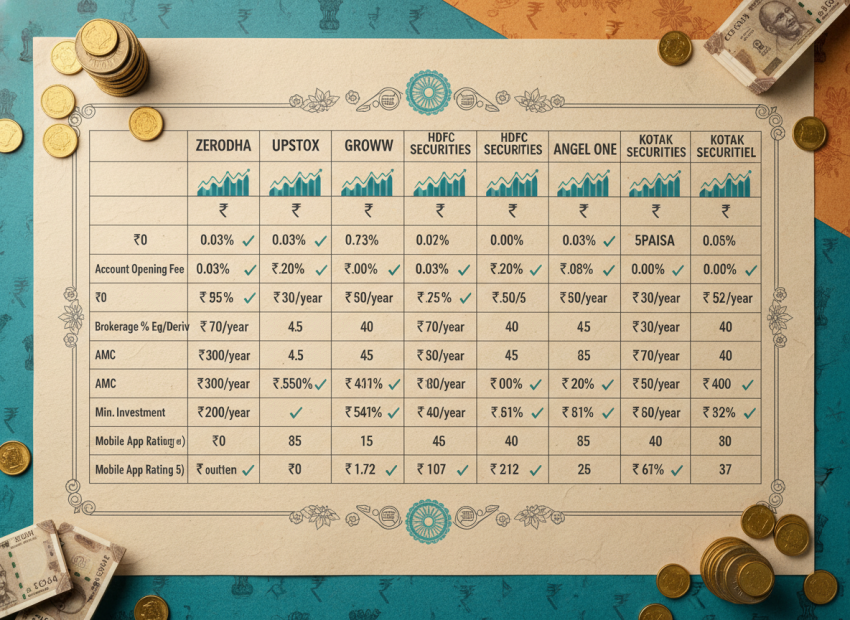
The Indian stockbroker landscape has undergone a radical transformation over the last decade, shifting from traditional physical trading to a digital-first ecosystem. Driven by the Digital India initiative and the simplification of Aadhaar-based e-KYC processes, the barrier to entry for retail investors has effectively vanished. Historically dominated by legacy bank-based firms, the market now witnesses a fierce rivalry between tech-centric discount brokers and established full-service intermediaries.
Key factors driving this evolution include:
-
Mobile-First Trading: High-performance mobile applications have replaced complex desktop terminals for the average user.
-
Regulatory Oversight: Stringent SEBI regulations have significantly enhanced transparency and investor protection.
-
Democratization of Data: Real-time analytics and research tools, once exclusive to institutional players, are now accessible to retail traders.
This shift ensures that whether you prioritize low-cost execution or high-touch advisory, the current ecosystem offers a specialized platform tailored to your specific financial objectives.
Categorizing the Best Brokers: Discount vs. Full-Service
Building on our understanding of India’s rapidly evolving stockbroker landscape, it’s crucial to categorize the diverse offerings available to investors. The market has largely bifurcated into two primary models: discount brokers and full-service brokers, each catering to distinct investor needs and preferences. This fundamental distinction shapes everything from fee structures to the range of services provided.
Understanding the core differences between these two models is paramount for making an informed decision. While both facilitate trading and investment, their operational philosophies and value propositions vary significantly, impacting your overall trading experience and cost efficiency.
The Rise of Discount Brokers for Cost-Effective Trading
The emergence of discount brokers has fundamentally disrupted the Indian financial landscape. By leveraging a technology-first approach, these firms have stripped away the overhead costs associated with physical branches and dedicated advisory teams. Instead, they offer a flat-fee brokerage model—typically charging a fixed rate like ₹20 per executed order—regardless of the trade volume.
Key advantages include:
-
Zero Brokerage on Equity Delivery: Most discount brokers charge nothing for long-term investments.
-
Advanced Trading Interfaces: High-speed platforms designed for active intraday and derivatives traders.
-
Transparency: Clear, upfront pricing without hidden percentage-based commissions.
This model is ideal for self-directed investors who prioritize cost-efficiency and robust digital tools over personalized investment advice.
Benefits of Full-Service Brokers for Research and Advisory
In contrast to the self-service model of discount brokers, full-service brokers offer a comprehensive suite of value-added services. These firms provide in-depth research reports covering equities, derivatives, and macroeconomic trends, empowering investors with informed decision-making. Clients benefit from personalized investment advice, often delivered by dedicated relationship managers who understand individual financial goals and risk appetites.Beyond just trading, full-service brokers extend their offerings to include:
- Wealth Management: Tailored solutions for portfolio construction and management.
- Advisory Services: Expert recommendations for IPOs, mutual funds, and other investment products.
- Offline Support: Access to physical branches and dedicated customer service for complex queries.
Critical Selection Criteria for the Top 10 Rankings
Selecting the right intermediary in the Indian stock market requires more than just looking at a brand name. To establish our top 10 rankings, we employ a rigorous framework that balances cost-efficiency with operational excellence. While the choice between discount and full-service models sets the stage, the granular details of a firm’s infrastructure determine its long-term viability for your portfolio.
We prioritize transparency and reliability, ensuring that every SEBI-registered broker on our list meets high standards for both casual investors and high-frequency traders. Our evaluation focuses on several key pillars:
-
Total Cost of Ownership: Moving beyond headline rates to find true value.
-
Platform Reliability: Assessing uptime and execution speed during peak volatility.
-
Regulatory Compliance: Ensuring strict adherence to exchange mandates.
Analyzing Brokerage Fees and Hidden Transaction Costs
Cost efficiency is the cornerstone of any profitable trading strategy. When evaluating the top 10 brokers, we look beyond the headline "zero brokerage" claims to uncover the true cost of trading.
-
Brokerage Models: Discount brokers typically utilize a flat-fee model (e.g., ‡20 per executed order), while full-service firms often charge a percentage (0.1% to 0.5%) of the total turnover.
-
Statutory Levies: These are mandatory charges including Securities Transaction Tax (STT), GST, and SEBI turnover fees.
-
Hidden Costs: Investors must account for DP charges on sell transactions, Account Maintenance Charges (AMC), and "Call & Trade" fees, which can significantly impact net returns for active traders.
Evaluating Trading Technology and Mobile App Stability
Beyond cost, the robustness of a broker’s digital infrastructure is paramount. For active traders, platform uptime and low latency are non-negotiable, especially during high-volatility events like market openings or major economic announcements.
Key technological benchmarks include:
-
Mobile App Stability: Seamless execution with biometric security and real-time data synchronization.
-
Charting Tools: Integration with TradingView or ChartIQ for advanced technical analysis and multi-chart layouts.
-
Order Types: Availability of GTT (Good Till Triggered), Cover, and Bracket orders to manage risk effectively.
-
API Ecosystem: Robust REST APIs for those automating strategies via Python or third-party bridges.
A broker might offer zero brokerage, but if the app freezes during a pivot point, the potential losses can far outweigh any fee savings.
In-Depth Analysis of India’s Leading Discount Brokers
The shift toward discount brokerage models has fundamentally altered the Indian investment landscape, democratizing access to the share market for millions. By decoupling high-touch advisory services from core execution, these platforms offer a lean, tech-first approach that appeals to both cost-conscious beginners and high-frequency traders. These SEBI registered brokers have moved beyond mere price competition, now focusing on robust infrastructure and seamless digital onboarding.
In this section, we evaluate the market leaders that have redefined the online trading experience. We examine how these firms balance low brokerage charges with sophisticated tools, ensuring that your demat account serves as a powerful gateway to equity, derivatives, and mutual funds.
Zerodha and Upstox: Benchmarking the Industry Pioneers
Zerodha and Upstox represent the vanguard of India’s discount brokerage revolution. Zerodha, the current market leader, pioneered the flat-fee model, charging zero for equity delivery and a maximum of ₹20 for intraday and F&O trades. Its Kite platform is lauded for its minimalist design and high uptime, making it the gold standard for reliability.
Upstox, backed by marquee investors like Ratan Tata, competes fiercely with its Upstox Pro platform, offering advanced charting tools and seamless API integrations for algorithmic traders. While both maintain a similar pricing structure, Zerodha focuses on a clean, ad-free ecosystem, whereas Upstox frequently integrates value-added services like gold investments and tax-filing tools directly within its interface to enhance the user journey.
Groww and Angel One: User Experience and Accessibility
While Zerodha leads in volume, Groww has captured the millennial market through its minimalist design. By stripping away intimidating jargon, Groww simplifies the transition from mutual funds to direct equity. Its "one-click" philosophy makes it arguably the most accessible platform for beginners in the Indian share market.
In contrast, Angel One bridges the gap between discount pricing and full-service heritage. Their Super App integrates several advanced features:
-
ARQ Prime: AI-driven investment recommendations and rule-based engines.
-
Smart Money: Comprehensive educational resources for technical and fundamental analysis.
-
Margin Trade Funding (MTF): Enhanced liquidity options for active intraday traders.
Angel One’s strength lies in its hybrid model, offering sophisticated tools and advisory services that pure discount brokers often lack, making it a versatile choice for those transitioning from novice to intermediate trading levels.
Reviewing Top-Tier Full-Service and Bank-Based Brokers
While discount brokers dominate the volume-driven retail space, full-service and bank-based brokers remain the backbone for investors seeking a holistic financial experience. These institutions bridge the gap between simple execution and comprehensive wealth management by offering 3-in-1 account structures that integrate banking, demat, and trading services into a single ecosystem.
This synergy provides unparalleled convenience, particularly for high-net-worth individuals (HNIs) who prioritize premium research, dedicated relationship managers, and seamless fund transfers. In this segment, we examine the heavyweights that leverage institutional trust and extensive physical branch networks to provide a more personalized investment journey than their digital-only counterparts.
ICICI Direct and HDFC Securities: Integrated Banking Ecosystems
Moving beyond standalone full-service offerings, ICICI Direct and HDFC Securities exemplify the power of integrated banking ecosystems. These platforms provide unparalleled convenience by linking trading and demat accounts directly with their respective bank accounts. Users benefit from a single login for banking and investments, facilitating instant fund transfers and a consolidated view of their financial portfolio. This seamless integration caters to clients who prioritize convenience, security, and a holistic financial management experience, often leveraging the extensive research and advisory services inherent to these established banking giants.
Kotak Securities and Motilal Oswal: Premium Research and Wealth Management
While ICICI and HDFC focus on banking integration, Kotak Securities and Motilal Oswal distinguish themselves through specialized advisory and high-conviction research. Kotak Securities bridges the gap between banking and trading with its Trade Free Plan, offering zero brokerage on intraday trades while maintaining a premium research desk that caters to both retail and institutional clients.
Motilal Oswal is widely regarded as a leader for equity research in India. Their ‘Solid Research, Solid Advice’ philosophy caters to investors seeking long-term wealth creation through:
-
In-depth Reports: Comprehensive coverage of over 250 stocks across 20+ sectors.
-
Personalized Advisory: Dedicated relationship managers and wealth management services for high-net-worth individuals (HNIs).
-
Phygital Model: A unique blend of advanced digital platforms and physical branch support for localized assistance.
Both firms are ideal for users who prioritize expert insights and portfolio guidance over the lowest possible transaction costs.
Tailoring Your Choice: Best Brokers for Different User Personas
Having thoroughly reviewed the capabilities of both discount and full-service brokers, including their technology, fees, and research offerings, it’s evident that the ‘best’ broker is highly subjective. Your optimal choice hinges on your unique investment objectives, trading frequency, and level of experience. This section aims to simplify that decision by categorizing brokers based on different user personas, ensuring you find a platform that perfectly aligns with your financial journey and trading style.
Top Picks for Beginners and Long-Term Investors
Building on the understanding that broker choice is personal, beginners and long-term investors prioritize simplicity, low costs, and reliable support. For those new to the market or focused on wealth accumulation, Zerodha stands out with its intuitive platform and zero brokerage on equity delivery trades, making it highly cost-effective for long-term holdings. Groww and Angel One also offer extremely user-friendly interfaces, simplifying the investment journey for novices, alongside robust mobile apps and access to mutual funds. For long-term investors seeking integrated financial services and comprehensive research, ICICI Direct and HDFC Securities provide a more traditional, full-service experience, albeit with higher charges, offering extensive research reports and advisory services that can guide strategic portfolio building.
Advanced Platforms for Intraday and Derivatives Traders
For active market participants, execution speed and technical depth are non-negotiable. Zerodha Kite remains a benchmark for its clean interface and robust API ecosystem, while Upstox offers advanced charting tools and high-speed order execution. Angel One caters specifically to derivatives traders with its integrated ‘InstaTrade’ feature, simplifying complex option strategy execution.
Key platforms for high-frequency trading include:
-
Fyers: Renowned for its deep TradingView integration and ‘Trade from Charts’ functionality.
-
Dhan: Gaining rapid traction for its dedicated ‘Options Trader’ app and lightning-fast execution.
-
Kotak Securities: Offers the ‘Trade Free Plan,’ which is highly cost-effective for intraday speculators.
These platforms provide essential tools such as Margin Trading Facility (MTF), customizable screeners, and support for algorithmic trading via Python-based APIs.
Getting Started: Account Opening and Regulatory Safety
Once you have selected a platform that aligns with your trading style, the next step is navigating the formal onboarding process. In India’s digitized financial ecosystem, transitioning from a prospective investor to an active market participant is remarkably efficient, yet it requires strict adherence to specific documentation standards.
Beyond the ease of setup, understanding the regulatory framework is paramount for long-term peace of mind. This section outlines the essential steps to activate your trading capabilities while highlighting the institutional safeguards that protect your assets from systemic risks and broker-level discrepancies. Ensuring your chosen partner is fully compliant is the final pillar of a successful investment strategy.
The Online KYC and Demat Account Opening Process
Opening a demat account in India has transitioned from a paper-heavy ordeal to a streamlined, digital-first experience. Most top-tier brokers now leverage Aadhaar-based e-KYC, allowing users to activate accounts within hours.
Essential Documentation:
-
PAN Card: Mandatory for tax and identity tracking.
-
Aadhaar Card: Linked to a mobile number for OTP-based e-signing.
-
Bank Proof: A cancelled cheque or statement to link your primary account.
-
Income Proof: Required only for those trading in Derivatives (F&O).
The process typically involves filling out a digital form, uploading scanned documents, and completing an In-Person Verification (IPV) via a short live video or selfie. Once the broker and the Depository (NSDL or CDSL) verify the data, your unique BO ID is generated, granting immediate market access.
SEBI Regulations and Ensuring Your Investment Safety
The Securities and Exchange Board of India (SEBI) acts as the primary watchdog, ensuring that every broker on our top 10 list adheres to stringent operational guidelines. Your safety is anchored by several key mechanisms:
-
Segregation of Funds: Brokers are mandated to keep client funds in separate accounts from their own corporate capital to prevent any misuse.
-
Investor Protection Fund (IPF): Stock exchanges maintain these funds to compensate investors in the rare event of a broker default.
-
SCORES Portal: A centralized, digital platform for lodging and tracking complaints against intermediaries with time-bound resolutions.
-
Depository Safety: Your shares are held with NSDL or CDSL, not the broker, ensuring your assets remain secure even if the brokerage firm faces financial distress.
Choosing the Right Partner for Your Financial Journey
Selecting the right stockbroker is the cornerstone of your investment success in India. Whether you prioritize the low-cost efficiency of a discount broker or the comprehensive research of a full-service firm, your choice must align with your specific trading frequency and financial goals.
Consider these final factors before committing:
-
Trading Style: Are you a long-term investor or a high-frequency scalper?
-
Support Needs: Do you require a dedicated relationship manager or are you self-sufficient?
-
Tech Reliability: Is the mobile interface intuitive and stable during peak market volatility?
The top 10 brokers reviewed provide a secure gateway to the Indian markets. Evaluate your priorities and begin your wealth-creation journey with a partner that scales with your ambitions.