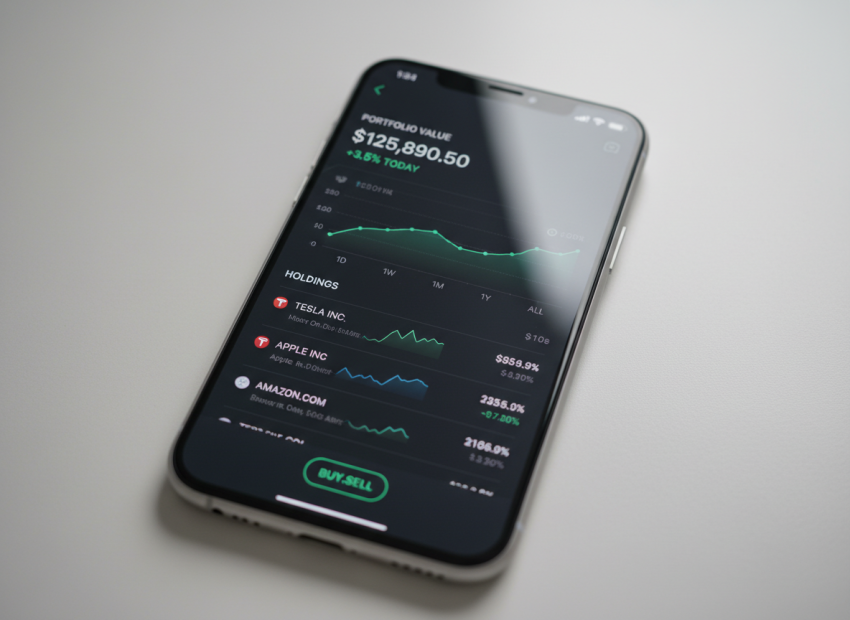
The landscape of retail investing has undergone a seismic shift. Gone are the days when executing a trade required a desktop terminal or a phone call to a high-commission broker. Today, the mobile stock market app has democratized access to global exchanges, putting sophisticated tools into the palms of millions. This "new era" is defined by the aggressive rise of commission-free trading and highly intuitive investment platforms that cater to both the novice and the seasoned professional.
As retail participation hits record highs, the competition among brokerage services has intensified. Investors now prioritize:
-
Cost Efficiency: Minimizing trading fees comparison across different providers.
-
Accessibility: Seamless user interfaces that simplify complex market data.
-
Functionality: Real-time execution and diverse asset availability.
Choosing the right stock trading app is no longer just about convenience; it is a strategic decision that impacts long-term portfolio growth and the overall efficiency of a brokerage account.
Critical Benchmarks for Evaluating Stock Brokerage Apps
As mobile investing continues to redefine market access, discerning the truly superior stock brokerage apps requires a rigorous evaluation framework. Beyond the initial allure of convenience, investors must scrutinize several critical benchmarks to ensure a platform aligns with their financial objectives and trading style.
This section delves into the fundamental criteria that separate leading apps from the rest, moving beyond superficial features to uncover what truly matters for a robust and reliable investment experience.
Fee Transparency and Commission-Free Models
Following the introduction of critical benchmarks, the first and arguably most impactful criterion for many investors is the fee structure. The rise of "commission-free" trading apps has revolutionized the industry, but this term often requires closer scrutiny. While direct per-trade commissions have largely disappeared from many popular platforms, investors must remain vigilant regarding other potential costs. A truly superior app provides absolute clarity on all charges, including spreads, payment for order flow (PFOF), withdrawal fees, and potential inactivity charges. Transparent fee models empower users to accurately assess the true cost of their investments, preventing unwelcome surprises and fostering long-term trust. Prioritizing apps that clearly outline their revenue streams beyond direct commissions is paramount for cost-conscious traders.
Interface Accessibility and User Experience Design
Beyond cost, the User Experience (UX) is the primary driver of investor success on mobile platforms. A well-designed stock trading app must translate complex market data into an actionable, intuitive interface. Key benchmarks for accessibility include:
-
Intuitive Navigation: Users should reach the trade screen in three taps or fewer.
-
Data Visualization: Clear, interactive charts that allow for basic technical analysis without cluttering the screen.
-
Stability and Latency: High-performance backends that prevent app crashes during high market volatility.
-
Personalization: Tailored watchlists and push notifications for price movements or corporate actions.
For the cost-conscious trader, a superior UI ensures that commission-free trading does not come at the price of execution errors. The integration of biometric security and seamless fund transfers further distinguishes top-tier brokerage services from mediocre alternatives.
Top-Rated Apps for Beginners and Long-Term Investors
Transitioning from technical benchmarks to real-world application, we now focus on the platforms that excel at lowering the barrier to entry for novice investors. For those prioritizing long-term wealth accumulation over high-frequency speculation, the ideal stock trading app must offer more than just a clean interface; it requires a supportive ecosystem that fosters financial literacy and disciplined habits.
These top-tier solutions bridge the gap between complex market data and actionable insights. By integrating commission-free trading with sophisticated automation, these platforms cater to users who value "set-and-forget" strategies. We will evaluate the industry leaders that have successfully democratized access to the brokerage account through intuitive educational pathways and innovative fractional ownership models.
User-Friendly Platforms with Educational Resources
For those entering the market, the ideal investment platform must balance simplicity with depth. Leading stock trading apps have pioneered the "education-first" approach, integrating bite-sized financial lessons and real-time news feeds directly into the user dashboard. This ensures users understand market mechanics before committing significant capital.
Key features that define top-tier beginner platforms include:
-
Paper Trading: Virtual accounts that allow novices to practice strategies in a risk-free environment.
-
In-App Glossaries: Instant definitions of complex financial terms like "dividend yield" or "market capitalization."
-
Curated News Feeds: Personalized updates that filter out market noise to focus on a user’s specific watchlist.
While commission-free trading is a major draw, the true value for a long-term investor lies in these pedagogical tools. A brokerage account that prioritizes financial literacy helps mitigate the risks of emotional trading, providing a more stable foundation for wealth accumulation than platforms focusing solely on execution.
Automated Investing and Fractional Share Capabilities
Beyond educational tools, the democratization of finance is most evident in fractional share trading. This feature allows investors to purchase a portion of a stock—often for as little as $1—rather than paying the full market price for a single share. This is a game-changer for high-priced equities, enabling immediate diversification for those with limited capital.
Complementing this is automated investing, which facilitates a "set-and-forget" approach. Many top-tier apps now offer:
-
Recurring Buys: Automatically purchasing assets at set intervals to leverage dollar-cost averaging.
-
Dividend Reinvestment Plans (DRIPs): Automatically using dividends to buy more shares, compounding growth.
-
Smart Portfolios: Algorithms that rebalance holdings to maintain a target risk profile.
These tools minimize emotional trading and ensure consistent market participation, making them essential for long-term wealth accumulation without the need for constant manual oversight.
Advanced Platforms for Active Traders and Technical Analysis
While automated tools and fractional shares provide an excellent entry point for long-term investors, active traders require a more sophisticated investment platform to navigate intraday volatility. For this demographic, the focus shifts from simple interfaces to high-performance stock trading apps that offer low-latency execution and deep analytical capabilities. To succeed in fast-moving markets, professional-grade tools are no longer optional. The following platforms are distinguished by their ability to handle high-volume throughput and provide the technical infrastructure necessary for complex trading strategies, including:
-
Enhanced Data Visualization: Moving beyond basic line graphs to comprehensive technical indicators.
-
Execution Precision: Access to diverse order types and leverage options.
-
Market Depth: Real-time insights into the order book and liquidity.
Professional-Grade Charting and Real-Time Data Feeds
For active traders and those employing technical analysis, the sophistication of charting tools and the reliability of data feeds are paramount. Advanced brokerage apps move beyond basic line graphs, offering professional-grade charting with a comprehensive suite of technical indicators, drawing tools, and multiple chart types (candlestick, bar, Heikin-Ashi). These platforms often provide: * Customizable Chart Layouts: Allowing traders to save preferred indicator sets and timeframes. * Real-Time Data Feeds: Essential for executing timely trades, these feeds provide instantaneous price updates, volume data, and market depth information, crucial for day traders and scalpers. * Historical Data Access: Extensive historical data is vital for backtesting strategies and identifying long-term trends. The best apps integrate these features seamlessly, ensuring minimal latency and high accuracy.
Margin Trading and Sophisticated Order Types
Beyond visual analysis, the execution of complex strategies requires robust order management. Advanced stock trading apps provide more than just simple market orders; they offer a suite of sophisticated order types designed to protect capital and automate entry/exit points. Key features include:
-
Conditional Orders: Including OCO (One-Cancels-the-Other) and bracket orders that allow traders to set profit targets and stop-losses simultaneously.
-
Trailing Stops: Essential for locking in profits during a trend while allowing for upside potential.
Furthermore, margin trading capabilities are a hallmark of professional-grade platforms. While it introduces significant risk, the ability to leverage a brokerage account allows for greater market exposure. Leading apps differentiate themselves through competitive margin rates and real-time monitoring to prevent forced liquidations. For the cost-conscious trader, comparing these interest rates is as vital as comparing trading fees, as they directly impact the net profitability of leveraged positions.
The Hidden Costs of ‘Free’ Trading Platforms
While advanced trading tools provide the technical edge needed for market success, the financial efficiency of a brokerage app is often obscured by marketing jargon. The rise of commission-free trading has revolutionized accessibility, yet it has also introduced a complex layer of indirect costs that can erode profit margins over time. For the cost-conscious investor, understanding that ‘free’ rarely means ‘zero cost’ is essential for long-term portfolio health.
Transitioning from technical capabilities to financial sustainability, it is vital to scrutinize the economic model of modern brokerage services. To truly evaluate the best stock brokerage apps, one must look beyond the headline claims and examine the structural costs embedded within the platform’s operations.
Understanding Spreads and Payment for Order Flow (PFOF)
While "zero-commission" is a powerful marketing tool, the revenue must be generated elsewhere. The primary mechanism is Payment for Order Flow (PFOF). In this model, your brokerage routes your trade requests to wholesale market makers rather than directly to a public exchange. These market makers pay the broker a small fee for the privilege of executing your trade, which can create a conflict of interest regarding execution quality.
The trade-off for the investor often manifests in the bid-ask spread. Even a fraction of a cent difference can impact your bottom line over time.
-
The Spread: The gap between the buy and sell price; wider spreads mean you pay more to enter a position.
-
Execution Quality: Brokers using PFOF may not always provide the "Price Improvement" found on institutional-grade platforms.
| Feature | PFOF Model (Commission-Free) | Direct Market Access (DMA) |
|---|---|---|
| Upfront Cost | $0 | Per-share or flat fee |
| Execution Speed | Variable | High |
| Price Improvement | Minimal | Often significant |
For high-volume traders, a slight widening of the spread can eventually exceed the cost of a traditional commission.
Withdrawal Fees, Inactivity Charges, and Subscription Tiers
Beyond the indirect costs of spreads and Payment for Order Flow, investors must also contend with a range of explicit administrative fees. Withdrawal fees are a common charge, particularly for expedited transfers or wire services, which can range from a few dollars to upwards of $25 per transaction. While ACH transfers are often free, understanding the fee structure for different withdrawal methods is crucial.
Another often-overlooked cost is the inactivity charge. Some brokers impose monthly or quarterly fees on accounts that remain dormant for a specified period, typically 3-6 months, especially if the account balance falls below a certain threshold. Finally, many "free" platforms offer subscription tiers that unlock advanced features, premium research, or lower margin rates, effectively turning a seemingly free service into a recurring expense for active or sophisticated users.
Security Standards and Regulatory Protection for Retail Investors
Beyond the immediate impact of trading costs, the structural integrity of a brokerage platform serves as the ultimate safeguard for your wealth. For retail investors, navigating the mobile-first landscape requires a rigorous assessment of how a provider handles both legal compliance and digital fortification.
When evaluating a potential app, you must look past the user interface to verify the underlying regulatory oversight and technical security measures. These elements form the bedrock of trust, ensuring that your capital is not only working for you but is also shielded from systemic risks and cyber vulnerabilities. Understanding these protections is vital for maintaining long-term confidence in your chosen investment vehicle.
Insurance Coverage and Brokerage Licensing
Building on the foundational need for security, a critical safeguard for retail investors is robust insurance coverage. In the United States, the Securities Investor Protection Corporation (SIPC) protects securities and cash in customer accounts up to $500,000, including $250,000 for cash claims. Similarly, the Financial Services Compensation Scheme (FSCS) in the UK offers protection up to £85,000 per eligible person per firm. These schemes provide a vital safety net in the event of a brokerage firm’s failure, not against market losses.
Beyond insurance, regulatory oversight is paramount. Reputable brokerage apps must be licensed and regulated by recognized financial authorities such as the U.S. Securities and Exchange Commission (SEC) and Financial Industry Regulatory Authority (FINRA), the UK’s Financial Conduct Authority (FCA), or the Australian Securities and Investments Commission (ASIC). This licensing ensures brokers adhere to strict operational, financial, and ethical standards, providing a layer of accountability and investor protection against fraud and malpractice.
Multi-Factor Authentication and Data Encryption Protocols
While regulatory frameworks provide a safety net, technical security protocols serve as the frontline defense for your brokerage account. Modern stock trading apps must employ robust encryption and authentication to prevent unauthorized access and data breaches.
Key Technical Security Features:
-
Multi-Factor Authentication (MFA): Top-tier investment platforms require more than just a password. This includes SMS codes, authenticator apps, or hardware tokens. Biometric logins, such as FaceID and fingerprint scanning, are now industry standards for mobile access.
-
Data Encryption: Leading apps utilize AES-256 bit encryption for data at rest and TLS/SSL protocols for data in transit. This ensures that sensitive financial information remains unreadable to interceptors.
-
Session Management: Automatic timeouts and device recognition help mitigate risks if a mobile device is lost or stolen.
When evaluating trading platforms, prioritize those that offer granular security settings. A secure mobile stock market app should treat your digital identity with the same rigor as a traditional banking institution.
Final Verdict: Selecting the Best App for Your Financial Goals
Choosing the right stock trading app requires aligning your specific strategy with a platform’s core strengths. There is no "one-size-fits-all" solution in the current investment platform landscape; your choice should hinge on your trading frequency and capital size.
-
For the Passive Investor: Prioritize apps offering commission-free trading and fractional shares. These features allow for consistent, small-scale contributions to long-term portfolios without fee erosion.
-
For the Active Trader: Seek a brokerage account that provides advanced charting, low latency, and competitive margin rates, even if it involves a tiered subscription model.
-
For the Global Investor: Ensure the mobile stock market app supports international exchanges and handles currency conversions with transparent spreads.
Before committing, perform a final trading fees comparison that includes inactivity charges and withdrawal costs. The ideal app balances robust regulatory protection with an interface that facilitates, rather than hinders, your financial execution.